Coffee Table Design 5: A Layered Geometric Masterpiece
In the world of custom furniture and laser cutting, few projects offer the same dramatic impact as a well-executed multilayer structure. Coffee Table Design 5 stands out as a prime example of how precision engineering meets bold aesthetic vision. This is not merely a flat cutout; it is a complex, radial-inspired geometric composition designed to transform raw materials into a striking piece of functional art. Whether you are a professional fabricator looking to expand your portfolio or a hobbyist aiming to build a statement centerpiece for your living room, this design offers a unique blend of structural integrity and visual depth.
The Art of Multilayer Geometry
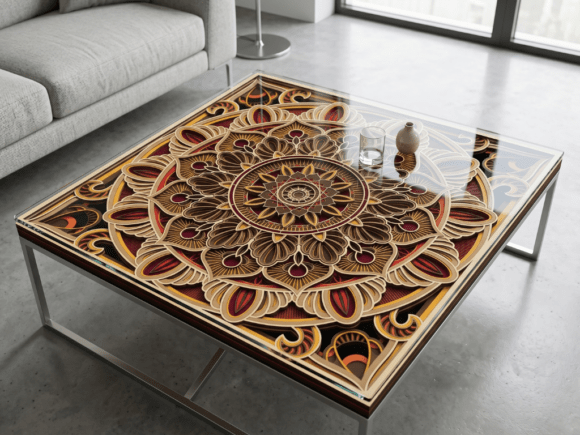
At its core, Coffee Table Design 5 is defined by its sophisticated layering system. Unlike traditional tables that rely on solid slabs or simple joinery, this design utilizes a progressive stacking method to create a three-dimensional illusion. The pattern features a radial geometry that radiates outward, generating a sense of movement even when the object is stationary. This dynamic quality makes the table an immediate focal point in any room, drawing the eye with its intricate interplay of light and shadow.
The design consists of ten distinct components, meticulously engineered to work in harmony. Nine individual layers form the body of the table, each contributing to the overall height and complexity of the shape. These layers are strategically arranged to enhance contrast and dimensional clarity. When stacked, they do not just sit on top of one another; they interlock visually to create a cohesive, sculptural form. The tenth component serves as a glass frame top, providing a sturdy surface while allowing the beauty of the underlying geometry to remain visible.
Why Precision Matters in Layered Designs
The success of Coffee Table Design 5 hinges entirely on accuracy. Because the design relies on nine separate pieces aligning perfectly, even minor deviations in cutting can compromise the final assembly. That is why the file structure is optimized for high-precision laser cutting. Each vector path is calculated to ensure clean, sharp cuts that minimize the need for post-processing sanding. This attention to detail ensures that when you assemble the layers, the fit is snug and the alignment is flawless.
For makers who value efficiency, this optimization translates directly into a smoother workflow. You spend less time correcting errors and more time focusing on the finishing touches. The result is a piece of furniture that feels robust and professionally crafted, rather than like a DIY experiment gone wrong. The structural consistency provided by these precise layers also means the table can support weight effectively, making it a practical choice for daily use.
Practical Applications Across Environments
While the primary application of this design is obvious—a stunning coffee table—its versatility extends far beyond the living room. The scalable nature of the files allows creators to adapt Coffee Table Design 5 for various contexts, from personal home decor to commercial installations.
- Residential Custom Builds: Homeowners seeking unique, non-mass-produced furniture can use this design to create a bespoke piece that reflects their personal style. It pairs exceptionally well with modern, industrial, or mid-century modern interiors.
- Commercial Interiors: Architects and interior designers can utilize this design for hotel lobbies, office waiting areas, or boutique showrooms. The bold geometric lines add a touch of sophistication and creativity to public spaces, signaling attention to detail and quality.
- Educational Workshops: For educators teaching woodworking or digital fabrication, this project serves as an excellent case study. It demonstrates the principles of nesting, kerf compensation, and structural layering in a tangible way.
- Small Business Ventures: Entrepreneurs running Etsy shops or local maker studios can leverage this design to create high-margin products. The perceived value of such a complex, hand-assembled piece often justifies a premium price point.
Scaling for Your Specific Needs
One of the most significant advantages of Coffee Table Design 5 is its scalability. The files are fully vector-based, meaning you can resize the design to fit any space without losing quality. Perhaps you have a small apartment and need a compact side table, or maybe you are furnishing a spacious atrium and require a massive centerpiece. The ability to adjust dimensions while maintaining the proportional integrity of the geometric pattern gives you complete creative control.
However, scaling requires thoughtful consideration of material thickness. If you enlarge the design significantly, you may need to increase the thickness of the wood or acrylic layers to maintain structural rigidity. Conversely, shrinking the design might require thinner materials to preserve the delicate details of the radial pattern. Understanding these relationships between scale, material, and function is key to successful implementation.
Material Selection and Finishing Considerations
When bringing Coffee Table Design 5 to life, your choice of material will dictate the final look and feel. While plywood and MDF are popular choices for their stability and ease of cutting, other materials can yield different results.
Consider using Baltic birch for a clean, edge-friendly finish that highlights the natural grain. Acrylic or polycarbonate can be used for a translucent, futuristic effect, especially if you plan to incorporate internal lighting. Even metals, if your machine is capable, could offer an industrial twist on the design. Regardless of the material, remember that the product images serve as visual references only. The actual appearance will vary based on your specific stock, finish, and machine settings.
The finishing process is equally critical. Since the design involves multiple layers, the edges will be exposed. A high-quality edge banding, staining, or clear coat can unify the layers and protect them from wear. For the glass top, ensure the frame is sized correctly to hold tempered safety glass securely. This combination of durable materials and careful finishing ensures the table remains beautiful and functional for years.
Strategic Benefits for Creators and Businesses
Implementing Coffee Table Design 5 offers several strategic benefits beyond aesthetics. For businesses, offering a product with such a distinctive design enhances brand identity. It signals innovation and craftsmanship, setting you apart from competitors selling generic furniture. The complexity of the design also creates a barrier to entry for low-cost imitators, protecting your market niche.
From a user experience perspective, the table provides more than just a surface for drinks and books. It acts as a conversation starter, engaging guests and clients with its unique form. In a professional setting, this can subtly influence perceptions of competence and creativity. For individuals, building or owning such a piece offers a deep sense of satisfaction, knowing that the object was created through skill and precision.
Final Thoughts on Implementation
As you prepare to cut and assemble Coffee Table Design 5, keep in mind that the journey is as important as the destination. Test cuts on scrap material are essential to dial in your power and speed settings. Take your time during the stacking phase to ensure every layer aligns perfectly before gluing. With patience and attention to detail, this ten-component masterpiece will reward you with a piece of furniture that is as strong as it is beautiful.
Whether you are refining your craft or furnishing a space, this design represents the perfect intersection of digital precision and physical artistry. By understanding its structure, potential applications, and material requirements, you are well-equipped to produce a result that exceeds expectations and stands the test of time.