Low Poly Scorpion 3D Model for Easy 3D Printing: A Practical Guide for Beginners
Entering the world of additive manufacturing often presents a steep learning curve, particularly when selecting the first digital file to print. The Low Poly Scorpion 3D Model for Easy 3D Printing addresses this challenge by offering a design that balances aesthetic appeal with technical reliability. Unlike high-resolution organic models that demand advanced slicing knowledge and precise calibration, this specific model utilizes a geometric, angular approach to create a striking visual representation of the arachnid while ensuring structural integrity during the printing process.
For hobbyists and professionals alike, the decision to use a low poly style is not merely an artistic choice but a strategic one regarding print success rates. This article explores the distinct characteristics of this model, compares it with alternative design philosophies, and evaluates its suitability for various user needs and skill levels.
Defining the Low Poly Aesthetic in Functional Printing
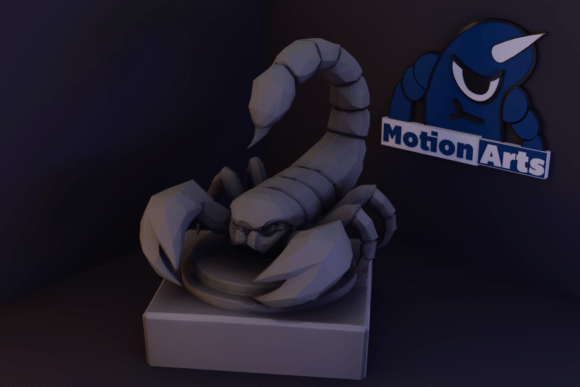
The term "low poly" refers to a 3D modeling technique that uses a relatively small number of polygons to represent objects. In the context of the Low Poly Scorpion 3D Model for Easy 3D Printing, this results in a design characterized by large, well-defined faces and sharp edges rather than smooth, curved surfaces. While traditional 3D printing often strives to mimic nature's fluidity, the low poly style embraces abstraction.
This distinction is critical for beginners. High-detail models frequently contain thin overhangs, intricate textures, and complex geometries that can lead to print failures such as layer shifting, clogging, or poor bed adhesion. By contrast, the scorpion model features thick volumes and simplified details. The absence of very thin parts significantly reduces the risk of breakage during removal from the build plate or handling after printing. The design maintains an imposing appearance through its silhouette and weight distribution, proving that high fidelity is not always necessary for a compelling final product.
Comparing Low Poly Models with Organic Alternatives
When evaluating 3D printing resources, users often face a choice between highly detailed organic models and stylized low poly versions. Understanding the tradeoffs between these categories is essential for managing expectations and resources.
Detail Versus Printability
Organic models, which attempt to replicate the natural texture of a scorpion's exoskeleton, require high resolution and often necessitate support structures for every leg and pincer. These supports can be difficult to remove without damaging delicate features. The Low Poly Scorpion 3D Model for Easy 3D Printing eliminates much of this complexity. Its angular surfaces allow for smoother extrusion paths, and the robust structure means fewer internal supports are required. For a beginner using a standard FDM printer, the time saved on support generation and post-processing is substantial.
Material Consumption and Time
Another factor in the comparison is efficiency. Detailed models often utilize more filament due to the need for dense infill to support fragile outer shells. The simplified geometry of the low poly scorpion allows for efficient material usage. Furthermore, because the model relies on larger surface areas rather than minute details, print speeds can often be increased without compromising the visual quality of the final piece. This makes it a cost-effective option for those testing new materials or colors.
Aesthetic Tradeoffs
It is important to acknowledge that the low poly style is not universally preferred. Users seeking photorealism or museum-grade replicas will find the geometric abstraction unsatisfactory. However, for decorative purposes, desk ornaments, or educational displays where the focus is on form and shape rather than biological accuracy, the stylized look offers a modern, artistic edge that blends well with contemporary interior design.
Technical Advantages for the Novice Printer
The primary value proposition of the Low Poly Scorpion 3D Model for Easy 3D Printing lies in its engineering for accessibility. Several specific features make it an ideal candidate for a first successful print or a quick project.
- Integrated Base: One of the most common failure points in 3D printing is warping at the base. This model includes an integrated platform, increasing the surface area in contact with the print bed. This enhances adhesion and stability, reducing the likelihood of the model detaching mid-print.
- Single-Piece Construction: Many complex animal models require printing in multiple sections and gluing them together. This adds a layer of difficulty involving alignment and finishing. The scorpion model is designed as a single piece, streamlining the workflow from slicing to completion.
- Weight Distribution: The design accounts for the center of gravity, ensuring the printed object stands upright without tipping. This is a crucial consideration for display pieces, as unstable models often result in frustration and wasted material.
- Forgiving Tolerance: Because the shapes are angular and voluminous, minor imperfections in layer height or flow rate are less visible than they would be on a smooth, curved surface. This tolerance makes the model suitable for printers that may not be perfectly calibrated.
Evaluating Use Cases and Limitations
While the Low Poly Scorpion 3D Model for Easy 3D Printing excels in many areas, it is not a universal solution. Determining the right fit requires analyzing the intended application.
Ideal Scenarios
This model is best suited for themed decorations, zodiac collections, or desk accessories where a bold, graphic look is desired. It serves excellently as a test print for new filaments, allowing users to verify their machine's performance on a challenging yet forgiving shape. Additionally, the clean, flat surfaces make it an excellent canvas for painting. Artists who wish to experiment with color blocking or geometric shading patterns will find the defined faces easier to paint than textured, organic models.
When to Consider Alternatives
If the goal is scientific education requiring anatomical precision, this stylized model may not suffice. Similarly, if the project demands a seamless integration into a realistic diorama, the angular aesthetic might clash with surrounding elements. In these cases, a high-poly STL file with smoothed curves would be the superior choice, provided the user has the necessary hardware and experience to manage the increased complexity.
Practical Implementation and File Format
From a technical standpoint, the model is provided in the standard STL format, ensuring compatibility with virtually all slicing software available today, including Cura, PrusaSlicer, and Simplify3D. Although the design is robust, the inclusion of supports is recommended for the raised legs and tail segments to ensure clean separation from the build plate. However, unlike intricate models where support removal is a nightmare, the supports here are minimal and easy to snap off.
For those operating within the Portuguese-speaking community, the description emphasizes the same core benefits: a "visual geométrico marcante" (striking geometric look) and a design "pensado para facilitar a impressão" (thought out to facilitate printing). This universality confirms that the design principles apply regardless of language barriers, focusing on the physical realities of the printing process.
Making the Decision
Selecting the right 3D model is a balance between ambition and capability. The Low Poly Scorpion 3D Model for Easy 3D Printing represents a sweet spot for adults aged 20–50 who are exploring 3D printing as a hobby or a creative outlet. It removes the intimidation factor associated with complex prints while still delivering a professional-looking result.
By prioritizing structural stability and simplified geometry, this model allows users to focus on mastering the fundamentals of slicing and machine operation rather than troubleshooting frequent failures. Whether used as a standalone decorative piece, a component of a larger collection, or a stepping stone toward more advanced projects, it offers a reliable entry point into the world of geometric 3D art. For those weighing options, the tradeoff of reduced biological detail for increased print success and ease of use is often a worthwhile investment in time and confidence.